 Choose Language
Choose Language
Choose Language
How we measure success in Texas public schools? Right now, standardized testing and an A-F accountability system that assigns grades to campuses is used almost entirely to grade our schools.
Accountability, and the transparency it brings, is essential. We need to make sure the 5.4 million students in Texas public schools are provided with the tools they need to eventually enter the workforce, and that taxpayer money is being put to good use.
But what if we had a system that looked at more than how students do on one test on one day? What if we decided that what makes a “good school” goes beyond test scores and we evaluated how districts prepare students for life and career through things like early childhood education, dual language, fine arts, and extra-curricular programs? Or the many crucial resources public schools provide to ensure the well-being of their students, like meals, mental health services, and campus security?
This is a wholly achievable idea — and one that had momentum and bipartisan support during the most recent legislative session. But, like so many other worthy public education issues, accountability and assessment reforms went down in the battle over private school vouchers during the 88th Session.
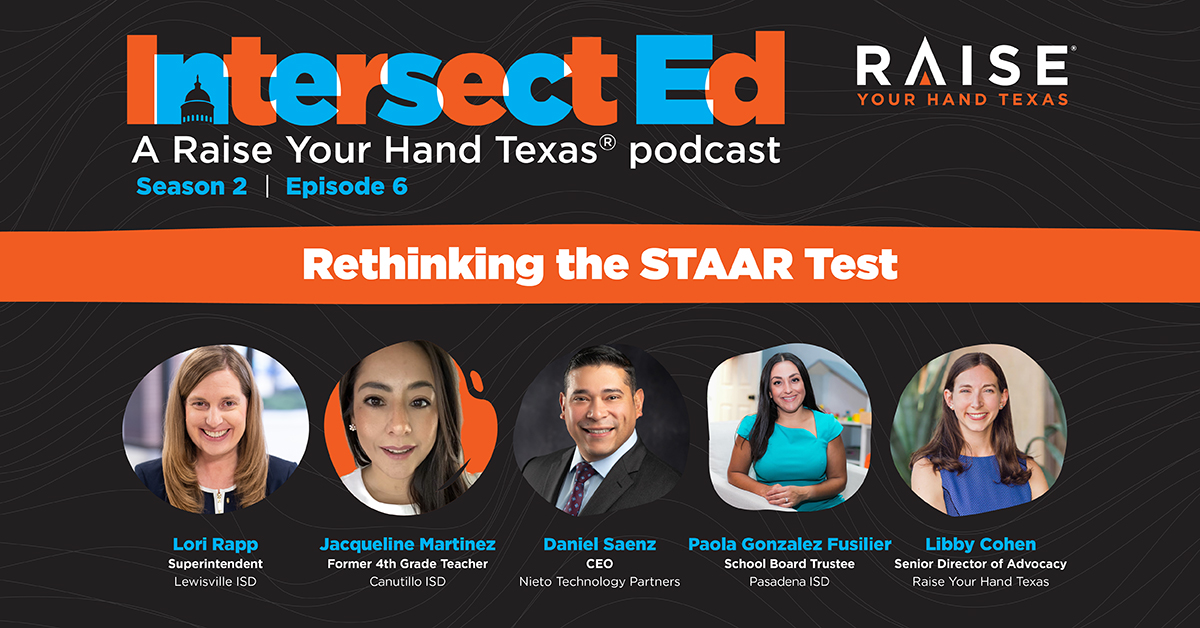
In this episode, hear from Lori Rapp, Superintendent at Lewisville ISD; Jacqueline Martinez, Former 4th grade teacher at Canutillo ISD; Daniel Saenz, CEO of Nieto Technology Partners; Paola Gonzalez Fusilier, School Board Trustee at Pasadena ISD; and Dr. Libby Cohen, Senior Director of Advocacy at Raise Your Hand Texas, each discusses assessment and accountability from their unique perspectives.
Note: Intersect Ed is best experienced as a podcast. If you are able, we encourage you to listen to the audio, which includes emotion and emphasis missing from the transcript.
MORGAN SMITH: Welcome to the Intersect Ed Podcast, where the stories of public education policy and practice meet.
I’m your host, Morgan Smith. Today, we’re talking about how we measure success in Texas public schools. Right now, that means standardized testing and an A-F accountability system that assigns grades to campuses almost entirely based on those tests.
Accountability, and the transparency it brings, is essential. We need to make sure the 5.4 million students in Texas public schools are provided with the tools they need to eventually enter the workforce, and that taxpayer money is being put to good use.
But what if we had a system that looked at more than how students do on one test on one day? What if we decided that what makes a “good school” goes beyond test scores and we evaluated how districts prepare students for life and career through things like early childhood education, dual language, fine arts, and extra-curricular programs? Or the many crucial resources public schools provide to ensure the well-being of their students, like meals, mental health services, and campus security?
This is a wholly achievable idea — and one that had momentum and bipartisan support during the most recent legislative session. But you know by now — especially if you listened to our most recent episode — that not much got done during the 2023 legislative session when it came to education policy. Like so many other worthy issues, accountability and assessment reforms went down in the battle over private school vouchers.
LORI RAPP: You know, really, I think as a district, where we are left with is, not enough substantive change when it comes to assessment and accountability that would really be more impactful and authentic for our students and our teachers.
MORGAN SMITH: This is Dr. Lori Rapp, the superintendent of Lewisville ISD, a district of about 50,000 students in the suburban Dallas-Fort Worth area. They also happen to be the largest employer in Denton County.
LORI RAPP: One of the things I’m so passionate about is how assessment and accountability practices actually are increasing what I believe is a teacher workforce crisis that we’re facing. And there really, out of this Session, was not enough steps taken to think about how to measure student learning in more varied ways.
MORGAN SMITH: In Texas, public school teachers are quitting in record numbers. A driving factor for that is low pay. But many of them also cite the chokehold standardized tests—and the role they play in the state’s accountability system—on what they do in the classroom.
Here is Jacqueline Martinez, who just finished her 13th—and what will probably be her last—year teaching in Texas public schools. Jacqueline says that the overemphasis on testing is a major reason she’s leaving the profession.
JACQUELINE MARTINEZ: Basically my entire teaching career, I always noticed that the goal always, we were always aiming for better performance, better scores or growth on the STAAR test. And throughout the year this is constantly the target, this is the goal. And a lot of what happens in the classroom revolves around the STAAR test.
MORGAN SMITH: A quick note for our listeners—throughout this episode, our guests make reference to “STAAR” or the “STAAR test”—many of you may know this already, but for those who don’t, that is the acronym for State of Texas Assessments of Academic Readiness—the name for the standardized tests that all Texas public school students are required to take.
Now back to Jacqueline.
JACQUELINE MARTINEZ: I think there’s this false narrative out there that teachers who don’t agree with all the over-testing that happens throughout the year, it’s some way of trying to avoid accountability or trying to dodge accountability and that’s not the case when it comes to testing. We’re teachers, of course, we want to make sure that our students are learning, but I think that there’s this very toxic culture that revolves around testing that has caused us to over-test kids and constantly have drill and kill in the classroom. And it puts this really unneeded and unnecessary stress and anxiety not only on teachers but on students. That’s exactly how it is in schools right now is that the goal is to always be performing well on benchmarks and testing. It doesn’t make the experience enjoyable for anybody, not for teachers or for kids.
MORGAN SMITH: Lori Rapp also spoke to me about the stress the accountability system places on teachers.
LORI RAPP: As I’m out there and I’m out in our schools all the time, it’s one of my big commitments to our community is to be with our teachers in their classrooms. And I see the authentic learning that’s taking place. I see the small group reading instruction at elementary. I see the work on the walls in the hallways. I see students who are loving learning. And so our teachers are doing such a great job of not letting that stress carry over into the classroom. They’re also doing a great job, in my opinion, of not letting school be all about how to take a standardized test, but the pressure that it puts on a teacher to constantly be thinking about, “how do I give them practice in the format of a standardized test,” can sometimes cause them to feel like they’re not able to really have the creativity they want to with the kids in their lessons. We work really hard in Lewisville ISD to ensure our teachers know, we want you to be creative. We don’t want the assessment and the accountability system to stifle the creativity of our teachers and our kids. But you definitely feel like you’re swimming upstream. When I think about the assessment and accountability system, I say all the time, “We don’t mind giving an assessment, multiple types of assessment.” We assess kids in all kinds of ways in our classrooms through varied assessments. What we do mind, is the fact that our schools are graded on such a narrow view of assessment. That’s concerning.
MORGAN SMITH: Then there’s of course the emotional toll high-stakes testing has on students, who begin taking STAAR exams at eight or nine years old in third grade. Paola Gonzalez Fusilier is a Pasadena ISD school board trustee and the mother of five public school students.
PAOLA GONZALEZ FUSILIER: Kids are brilliant. That’s what I always say. All kids, they always impress me so much, because I know that they’re not only paying attention, they’re in tune. Even if teachers are all day long telling them, “Just do your best,” they have this deep level of awareness that this is very important. And that whole pass/fail type feeling is a very big stressor. And I think for all kids, not just in my own family, but for all kids, that eventually becomes almost like a chronic stressor, right? So if we look at it from a mental health standpoint, you can’t really learn if you’re not well—mental health wise, right? So if you’re chronically stressed about something, then you’re likely not going to pick up at the regular pace or you’re not going to learn at your optimal level because you’re stressed out about something or it’s sitting there, just this underlying fear, or looming over you.
MORGAN SMITH: Paola is speaking not just from her experience as a school board trustee and parent, but also as a licensed professional counselor and registered play therapist.
PAOLA GONZALEZ FUSILIER: And so I really do think it affects the way that kids learn. I have seen a rise even over the last 10 years of just anxiety within my own caseload. And it gets younger and younger every year, just this anxious distress. And, through the PTA at my kids’ school, I teach every year. I teach a coping skills class for anxiety before the testing. The class keeps getting bigger and bigger every year that I teach it, and I love it. But one of the things that parents say is, “We also feel the stress.” And so often, we as parents, we’re the regulators for our kids, right? So if we’re stressed because they’ve told us that this test is so important, then we’re also unknowingly giving that back to our kids. And so I just think it’s a state of chronic stress in this weird way about testing.
MORGAN SMITH: Jacqueline Martinez, who spent the majority of her career teaching fourth grade reading, language arts, and social studies in El Paso’s Canutillo ISD, also noticed how hyper aware even the youngest students are of standardized testing.
JACQUELINE MARTINEZ: At the beginning of the year, whenever we’re doing icebreakers or getting to know our students and their personalities, a lot of times if you ask a student… And this won’t just be with 4th graders, this can go back all the way to 1st grade. But if you ask a student what they fear the most or what they worry about the most, it’s interesting that they will almost always say that they’re afraid of the STAAR test. So even before they come into a testing grade, which in Texas is 3rd grade, they’ve already heard of this test, they already are fearing it and having some kind of anxiety around the test. This is the focus all the time. And then there are people out there who will tell students, if you don’t pass this test you’re not going to go to the next grade level. And in my 13 years experience that’s not necessarily true. I’m not advocating for, hey, kids don’t do your best. You don’t have to do well on this test. But it’s fear mongering and I think it’s a huge disservice to students. It robs them of their ability to love learning just to learn, because the focus is always to do well on the test.
MORGAN SMITH: Paola said this emotional turbulence around testing does more than affect children’s ability to learn — it also throws off the data the state collects about what they do learn.
PAOLA GONZALEZ FUSILIER: I know we have to have some sort of accountability, and I understand that we have to have some sort of measure. But this one test that does not fit all, it needs to change in order for it to be something that we can actually cater to different students and to their needs and to be able to get actual data about our students, because right now I don’t feel like we’re even getting accurate data, because not all children test well.
MORGAN SMITH: But even if you put aside concerns about the effects of high stakes testing on the morale of educators and students, it’s hard to ignore the argument that it doesn’t provide an accurate measure of what’s happening in public schools. Let’s listen to a clip of state Rep. Glenn Rogers, a Republican from Palo Pinto County, speaking at Raise Your Hand’s Measure What Matters Day at the Capitol in April.
GLENN ROGERS: I believe that having a properly crafted accountability for the use of tax dollars for education is important and that we must do a better job of measuring the success that takes place every day in public schools across our great state. That is why I support measuring what matters in broadening our system of accountability to ensure that we are providing parents and taxpayers an accurate picture of that success. Our overreliance on the STAAR and other high-stakes tests has been a disservice to our children, their parents, and their educators for over 40 years, and it’s time for change.
[applause]
GLENN: We should be listening to parents, business owners, and other taxpayers in our communities that care about public education. Our expectations of those who are graduating from our schools should reflect their priorities, and our accountability system should measure progress toward those expectations. The accountability system should include measures that capture the impact of high-quality career and tech programs, fine arts programs, and accurately measure college, career, and military readiness, which truly cannot be determined by the STAAR or any other high-stakes test.
MORGAN SMITH: Business leaders and those who are most in touch with the state’s workforce, confirm this.
DANIEL SAENZ: I believe that the STAAR test does not give a clear indication of how a student can succeed in life.
MORGAN SMITH: This is Daniel Saenz, who is the CEO of Nieto Technology Partners, an IT firm that provides its services to over 300 clients across Houston. In addition to hiring for his own company, he also often helps find employees for his clients.
DANIEL SAENZ: If I were to look at a student’s STAAR score that doesn’t tell me how well they’re going to do under pressure, that’s not going to tell me how well they’re going to do in learning new things. It gives a snapshot of what they were taught at that moment to pass that test. Those are not life skills. Life skills are going to come from the student who maybe had a B score and ultimately got to A score over time. Success is an indicator of a student who has to work and go to school at the same time and is still doing both to the betterment of themselves and their family. The STAAR does not indicate that.
MORGAN SMITH: Gov. Greg Abbott is expected to call lawmakers back to Austin for a special session focused on private school vouchers—and possibly other education topics that could include assessment and accountability reform—this coming fall.
LIBBY COHEN: We got a good hint of what could be on the call for that special session with the charge that the speaker, Dade Phelan, gave to the members of a new select committee of House members who he has asked to make recommendations on a handful of education topics in anticipation of that special session, including vouchers, including a teacher pay raise and possibly some school funding, as well as assessment and accountability reform.
MORGAN SMITH: Dr. Libby Cohen is Raise Your Hand’s Senior Director of Advocacy. She spent much of the legislative session working with community leaders and other advocates on legislation that would reduce the consequences tied to high-stakes tests and expand the data the state uses to identify high-quality schools.
LIBBY COHEN: So assessment and accountability had been a key priority of Raise Your Hand’s throughout the interim and coming into the 88th Session. Our Measure What Matters campaign to expand the number of indicators used in the accountability system, really moves us away from over-reliance on one test on one day, had been going on for more than a year by the time January of 2023 rolled around. So we were really excited by the possibility of making headway on that issue this session.
Unfortunately, assessment and accountability reform like so many other issues, fell victim to voucher negotiations this session. I think if we’re looking for signs of encouragement on that front, though, some kind of assessment and accountability reform, unfortunately, in a way, it was a performative abolition of the STAAR test. It became one of the bargaining chips that was supposed to lure lawmakers into supporting vouchers.
I think we can be encouraged that the issue has gained enough traction that the people who wanted to pass something that was clearly unpalatable thought that doing something about the STAAR test might just be enough to get members to swallow the bitter pill of vouchers. I think that should be encouraging to people who hope to see more progress on this issue in the future, that there’s broad recognition that it’s popular and that it does have bipartisan support and some real legs in the legislature moving forward.
MORGAN SMITH: But in the expected upcoming special session at least, the fate of accountability reform likely will once again be tied to vouchers. That means that until lawmakers are able to find a way forward, we will have to continue to rely on public school students and teachers to figure out a way to make it through. Here’s Paola Gonzalez Fusilier once more.
PAOLA GONZALEZ FUSILIER: I think kids would say it themselves, and it’s that you can’t really measure what a child knows through one test or even two tests, right? You have to really get to know that child. There has to be different ways to assess progress. And it cannot be something that is so stressful, not just to children, but also to teachers and admin and everyone else. I think our children are super resilient. We know that they are. And I know that they will test and will get through it. But that’s not the way that we want them to view school, right? We want them to like school. We want them to want to learn and to grow and to keep going.
MORGAN SMITH: If you would like to review detailed policy recommendations from Raise Your Hand Texas based on more than a year of statewide community conversations, data collection, analysis, surveys, and research, please find the Measure What Matters Assessment and Accountability Council Report under the Policymakers section of Raise Your Hand Texas’s website.
To stay informed on critical education issues, you can sign up online for Raise Your Hand’s Across the Lawn weekly newsletter at www.RaiseYourHandTexas.org/Get-Involved.
To receive text alerts that will allow you to join Raise Your Hand in taking action at key moments in the lead up to the special session, text RAISEMYHAND to 40649.
Today’s episode was written by me, Morgan Smith. Our sound engineer is Brian Diggs and our executive producer is Anne Lasseigne Tiedt.