 Choose Language
Choose Language
Choose Language
The formalized practice of having more experienced teachers coach those newer in the profession has the potential to help with a major challenge facing Texas public schools — teacher shortages. It also benefits everyone involved, from the experienced teachers acting as mentors who now have a chance to learn new skills, to the newer teachers they are supporting, and to the students who now have confident, calm educators in the classroom.
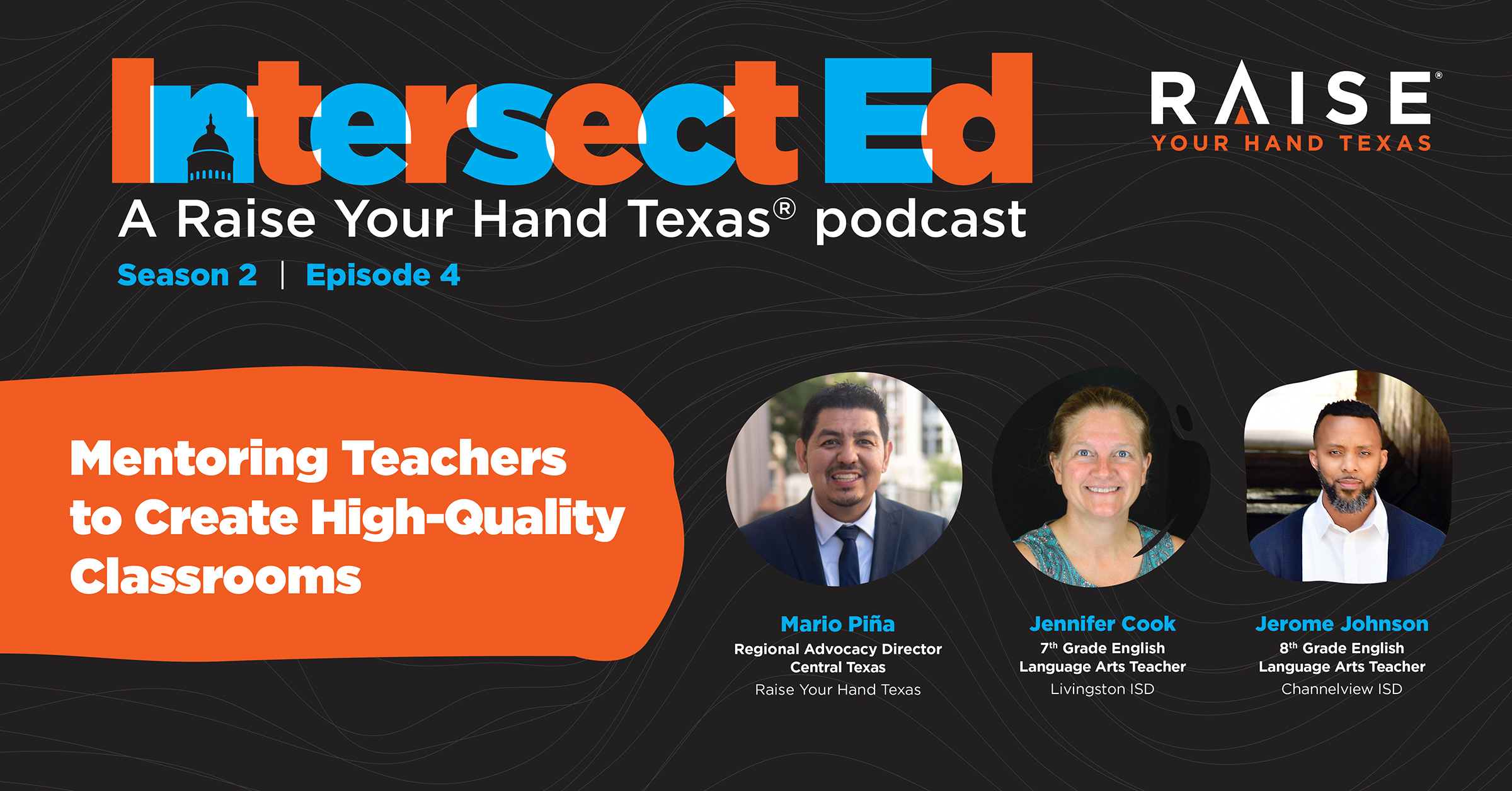
Hear from current and former teachers Mario Piña, Regional Advocacy Director – Central Texas at Raise Your Hand Texas, Jennifer Cook, 7th Grade English Language Arts Teacher at Livingston ISD, and Jerome Johnson, 8th Grade English Language Arts Teacher at Channelview ISD in this episode. They will share how mentoring teachers can create higher-quality classrooms across Texas, and why Texas lawmakers need to take the framework of what’s already a good program and expand it so that more teachers — whether veteran or new in the classroom — can benefit from teacher mentoring for generations to come.
Note: Intersect Ed is best experienced as a podcast. If you are able, we encourage you to listen to the audio, which includes emotion and emphasis missing from the transcript.
Morgan Smith: Welcome to the Intersect Ed Podcast, where the stories of public education policy and practice meet. I’m your host, Morgan Smith.
Today we are talking about something that could make a positive difference in the lives of many Texas teachers and their students: high-quality mentorship.
The formalized practice of having more experienced teachers coach those newer in the profession could help with a major challenge facing Texas public schools — teacher shortages. It also benefits everyone involved — from the experienced teachers acting as mentors who now have a chance to learn new skills, to the newer teachers they are supporting, and to the students who now have confident, calm educators in the classroom.
So why aren’t high-quality mentoring programs more common in Texas public schools? Well, as is often the case, the reasons for that mostly come down to time and money.
Right now in Austin, some lawmakers are trying to change that by expanding an existing pilot mentorship program. Two proposals to would do that — House Bill 11 and Senate Bill 9 — have both passed their home chamber but are currently stuck in limbo waiting for hearings in the second. With less than two weeks left in the legislative session, time is running out for either of these bills to make it.
Morgan: While teachers can sometimes find peers to reach out to organically, research shows formalized, high-quality mentorship programs deliver the best results — especially when it comes to teachers working with vulnerable student populations. And those programs have specific characteristics.
Mario Piña: A high-quality mentorship program has a lot of components. I think first of all, it has time for teachers to reflect with their mentors, and usually, this really needs to happen during the school day. And it needs to have time for the mentor to observe their mentee and vice versa because if they’re not being able to see what’s happening or how something can be done, they’re not going to be able to execute that in the way that’s most effective.
Morgan: Mario Piña is a Regional Advocacy Director with Raise Your Hand Texas. Before joining them in 2022, he spent nine years in Austin ISD as an elementary and middle school teacher, and instructional coach.
Mario: And I think definitely making sure that we’re paying people. A lot of times in school districts, people are being asked to be mentors and are not being compensated and not giving the time to mentor their mentees, and so it becomes really difficult for them to find the time during the day to really help each other out, and so it becomes more of a chore rather than a real mentorship process.
There’s so many other things that teachers are worried about. They’re worried about grading. They’re worried about making sure that their students are okay. They’re making sure they have high-quality lessons. And so having time to go talk to their mentor is probably at the very bottom of their list a lot of times.
And I think the other part of it is training for the mentors themselves. A lot of times, teachers are being asked to be mentors but are provided no training, and we have this idea that just because you’re a really good teacher, you’re going to be a really good mentor, and that’s not always the case. I know that when I was a teacher, a lot of the time my mentor would come and ask me, “Hey, what do you need help with?” And unfortunately, as a first- or second-year teacher, you don’t know what you need. And so asking me what I need help with or how am I doing isn’t always the most helpful, because I don’t know what I don’t know. And so we really need teachers to have that training of how to ask the questions, setting those goals and working on those goals together, and really guiding that novice teacher.
Morgan: A high-quality mentorship program can provide much-needed time for collaboration and support during the early days of teaching, which can be a trial-by-fire for many new educators. Mentors are also around to help new teachers figure out the simple everyday logistics that anyone who’s ever started a new job knows can be quite daunting — like making sure they know how to use the copier, or that there’s a bathroom in the teachers’ lounge. Most importantly, they help their mentees hone their instructional strategies and master classroom management – all skills that translate directly into improving students’ academic outcomes, which also makes mentoring programs an excellent financial investment for the state.
Jerome Johnson: It’s like that famous Mike Tyson quote, that everybody has a plan until they get punched in the mouth, metaphorically speaking. And so that’s what teaching is like that first year. You have this idea of how your day’s going to go, and then boom, a student does something totally not planned. You can imagine the things that we’ve seen.
Morgan: This is Jerome Johnson, who is in his sixth year teaching English Language Arts in Channelview ISD, a school district of about 9,000 students on the Gulf Coast. He grew up a few miles down the road from where he now teaches – and entered teaching in his mid-thirties after he felt a calling to work with students like the kids he grew up with.
Jerome: The calling kind of hit me and I was like, “I wonder if I can do this and be great at it, and be able to serve the underserved in a way?” I just always wanted to be a great educator in a place where they probably wouldn’t get good teaching, more than likely. I think those personal challenges are what drew me originally to teaching.
Morgan: For Jerome, having mentors during his first years in the classroom provided invaluable feedback — both positive and negative — that helped him grow as an educator.
Jerome: I think as a mentee coming into the profession at such an older age, it was important that I got that confirmation like, “You are equipped for this.” I remember being in a hallway and my mentor, one of my mentors at the time, just came to me and was like, “You have what it takes to …” She said, “You have that thing that teachers have to reach and connect with students.” And I had no idea what I was doing. I had no barometer, no way to measure it. I think that meant the world to me, just not knowing what to expect or am I on the right path…Because you’re in a silo unless you are in a different culture where collaboration is welcome. But if you are the professional in the room, and you are with a bunch of younger people, younger individuals, you just need those outside eyes telling you both good and bad. Because my colleagues have checked me on some things of like, “Yeah, that’s a little above what they’re talking about. You’re missing them with that language,” or, “You need to have this structure in your class to reach them.”
So both the critical and the compliments make a difference when you have those relationships. And I think mostly it took me a while, maybe three years in before I realized amongst teachers it’s really a people business, really about investing in individuals and people so they can reach their maximum potential.
Morgan: Most importantly, when teachers feel supported and encouraged, they can provide that same support and encouragement for their students. So in that way, high-quality mentoring ends up providing a safety net for students with new teachers, who are also often the students with the greatest needs. Here’s Mario again.
Mario: Our Title I schools are the ones that have the most revolving teachers, and I can think of, at the last school I worked at, more than half the campus is new. And so how are we going to continue to mentor these teachers when our veteran teachers are still in need of mentors themselves? And so our most vulnerable students are the ones who are suffering the most, and I don’t think we talk about that enough – and it’s hard to fulfill a high-needs classroom when you’re just struggling to stay afloat yourself.
Morgan: If you are feeling overwhelmed, it’s going to be very difficult for you to be an effective teacher. If you don’t know how to pace your curriculum, it’s going to be very difficult to be an effective teacher. If you can’t figure out how to manage behavior in your classroom, you aren’t going to be an effective teacher. High-quality mentorship shrinks the learning curve for new teachers on all of those things while increasing student achievement and decreasing teacher turnover.
Jennifer: Most people want to be given an opportunity to help somebody do more, or better, or bigger, or see things through a different lens, or whatever it is in that situation. That’s certainly been my experience. Then on the flip side, because I have benefited from mentors in my life, and mentorship opportunities, I also like being a mentor. So I think of it as the same as teaching actually. It’s just that you are helping guide a peer versus a student or a child, but the meat of it is still the same. That you are helping someone accomplish something in their life and that’s special, that’s meaningful.
Morgan: Jennifer Cook is heading into her 10th year in the classroom. She teaches 7th grade English Language Arts in Livingston ISD, a mid-sized school district in rural East Texas. Jennifer says she loves teaching middle school students — an age group she knows can be intimidating to some.
Jennifer: They want to learn, and they want to find their own voice and their own independence, and all of these things. But they’re old enough to where they can handle some pretty deep topics and some deep conversations. Just their capacity for what they can handle and how much they’re able to learn and get from anything, not just literature, but literally anything that you’re giving them access to, I think, is really special with this age group, the middle school age group.
Morgan: Jennifer is also a teacher who would not still be in the classroom if not for a mentor she had during a particularly difficult second year of teaching.
Jennifer: That year there were a few days where thinking about going to work brought tears to my eyes. And that’s a horrible experience to have, and no one should have to go through that. You should not be crying before you go to work. My co-teacher that year had been teaching for probably 35 years at that time, so she had been through everything. She not only helped me maintain a positive outlook, but she also helped me take a stressful situation and do what needed to be done, but also turn it into my own.
She helped me a lot and made me understand that not every year is going to be easy, but it’s still only a year, and there’s really nothing that we can’t get through. So you just have to find your voice and find a way to make it the best you can.
Morgan: Now Jennifer serves as a mentor herself. This year, she had two new-to-the-profession educators under her wing. But even though she knows from personal experience how important mentorship can be, she still struggles with finding time to meet with her mentees, and as the school year closes, has not had an opportunity to observe them in the classroom. There’s simply not enough time in the school day where teachers often have their schedules planned down to five-minute increments. She’s hopeful, though, that can change.
Jennifer: Everyone doesn’t have to be best friends, but when you trust each other, and you trust that you can discuss and work through situations, it just makes everyone happier, and more effective. So I really think that in every aspect of life, connecting with and keeping those connections and relationships is really key to growth. So this is one way that schools can try to manage the culture of their workplace through, I think, a pretty minimal amount of work.
Morgan: As the end of the legislative session approaches, Raise Your Hand Texas is pushing for lawmakers to take the framework of what’s already a good program and expand it so that more teachers — whether veteran or new in the classroom — and students — can benefit from it for generations to come.
If you want more details on the characteristics of a high-quality mentorship program, please visit the Raise Your Hand Texas blog post, “Investing in Teacher Mentorship Leads to Stronger Classrooms,” which is linked in the episode notes.
To stay informed on critical education issues, you can sign up online for Raise Your Hand’s Across the Lawn weekly newsletter at raise – your – hand – texas – dot -o-r-g – back slash – get – dash – involved.
To receive text alerts that will allow you to join Raise Your Hand in taking action at key moments this legislative session, text RAISEMYHAND– all one word – to 40649.
Today’s episode was written by me, Morgan Smith. Our sound engineer is Brian Diggs and our executive producer is Anne Lasseigne Tiedt.
Thank you for standing up for our Texas public school students.